
What is the meaning of Naivety in contemporary painting? -focused on Naive and primitive painting -
What is the meaning of Naivety in contemporary painting?
-focused on Naive and primitive painting -
An, Soon Geum
In this seminar, I will present why Naive painting is popular in these days through focusing on the background and features of Naive and Primitive painting. And then, I will examine a Korean painter Hwang Changbae from the point of view of Naive and Primitive painting.
Naive Painting
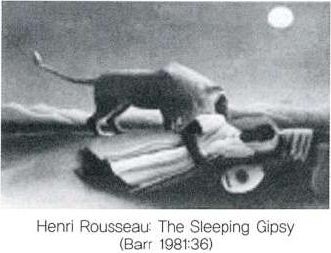
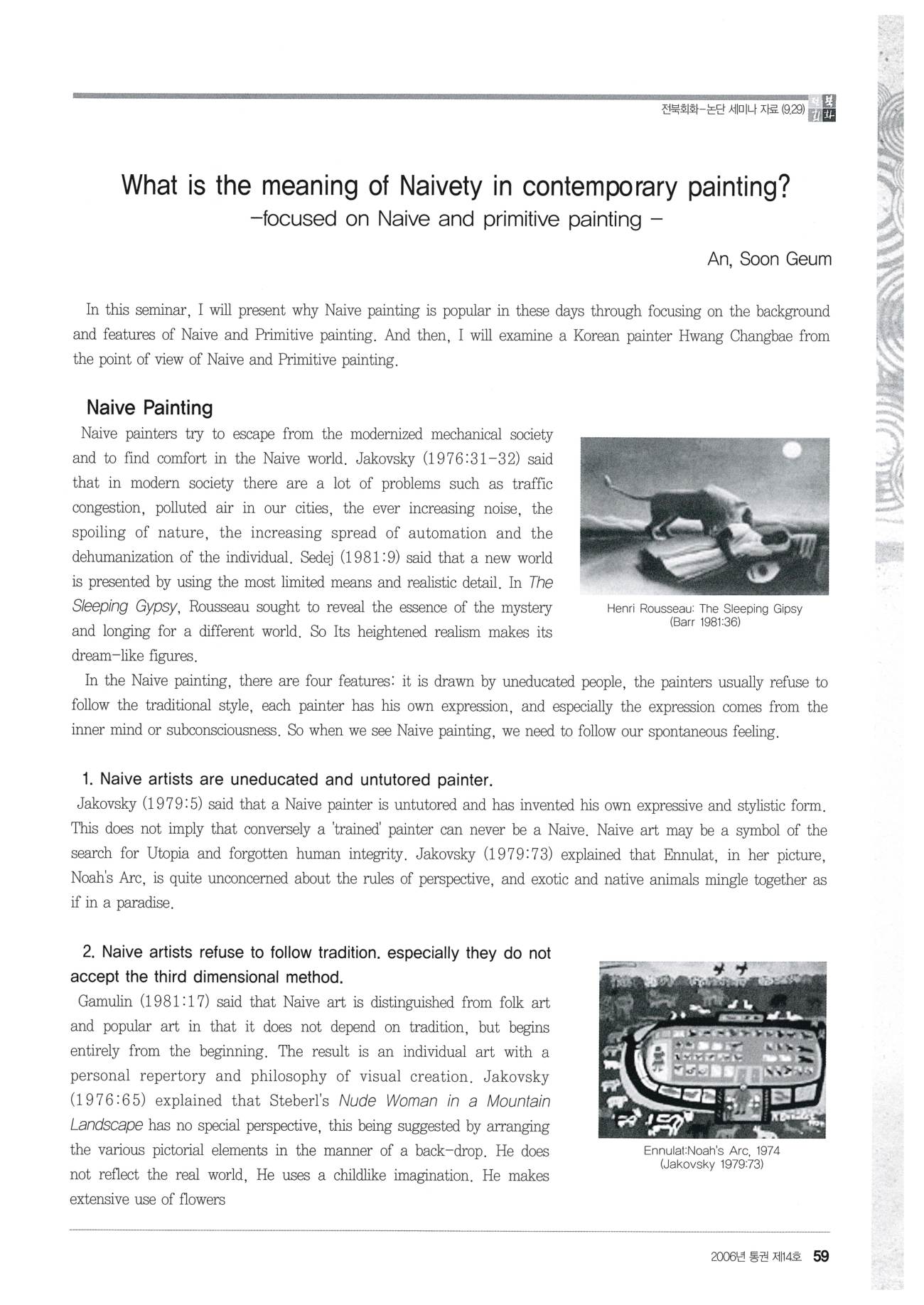
Naive painters try to escape from the modernized mechanical society and to find comfort in the Naive world. Jakovsky (1976:31-32) said that in modern society there are a lot of problems such as traffic congestion, polluted air in our cities, the ever increasing noise, the spoiling of nature, the increasing spread of automation and the dehumanization of the individual. Sedej (1981:9) said that a new world is presented by using the most limited means and realistic detail. In The Sleeping Gypsy, Rousseau sought to reveal the essence of the mystery and longing for a different world. So Its heightened realism makes its dream-like figures.
In the Naive painting, there are four features: it is drawn by uneducated people, the painters usually refuse to follow the traditional style, each painter has his own expression, and especially the expression comes from the inner mind or subconsciousness. So when we see Naive painting, we need to follow our spontaneous feeling.
1. Naive artists are uneducated and untutored painter.
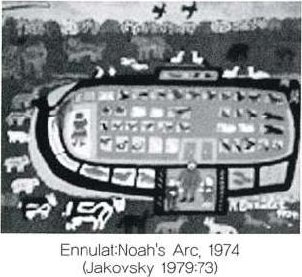
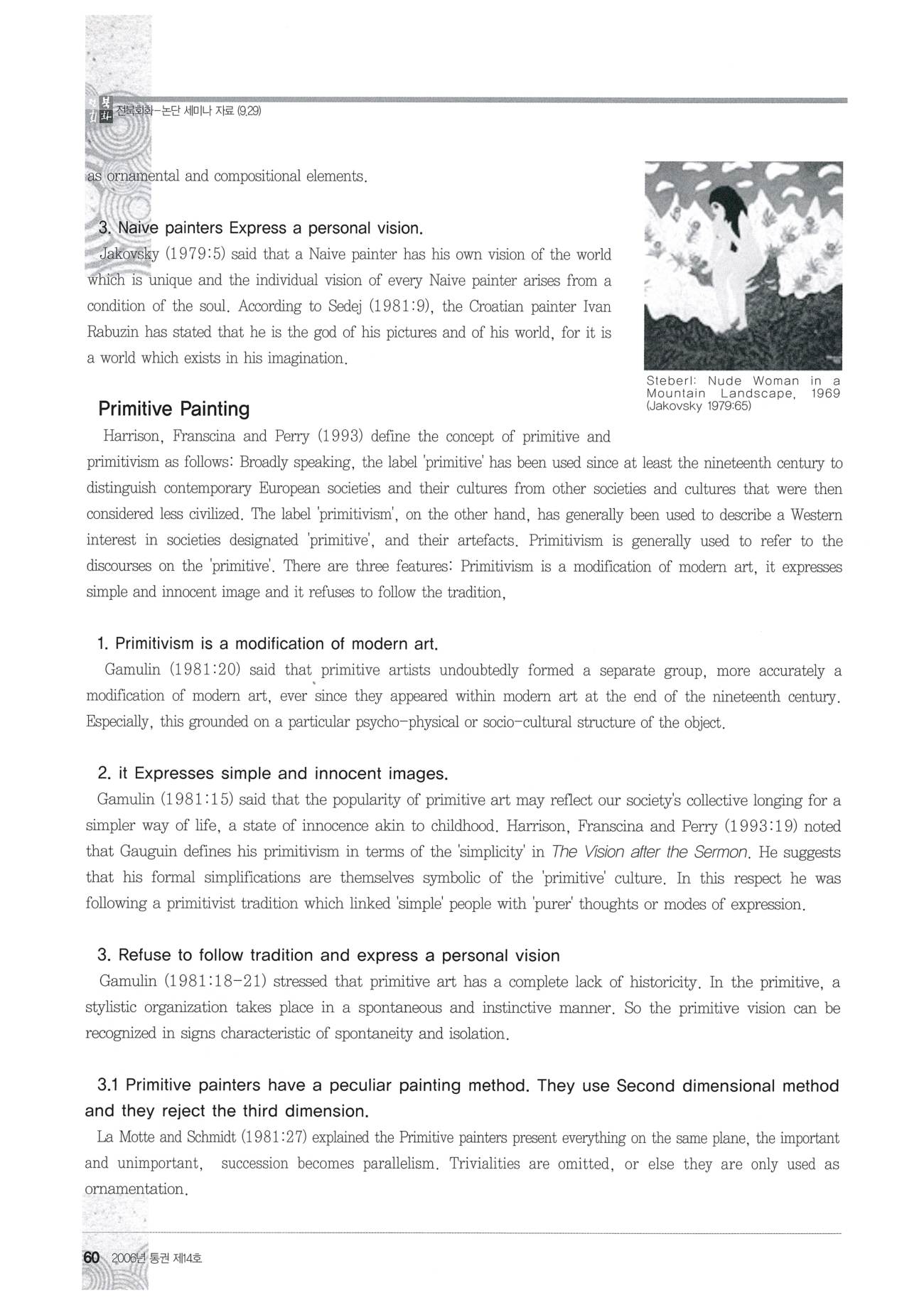
Jakovsky (1979:5) said that a Naive painter is untutored and has invented his own expressive and stylistic form. This does not imply that conversely a 'trained' painter can never be a Naive. Naive art may be a symbol of the search for Utopia and forgotten human integrity. Jakovsky (1979:73) explained that Ennulat, in her picture, Noah's Arc, is quite unconcerned about the rules of perspective, and exotic and native animals mingle together as if in a paradise.
2. Naive artists refuse to follow tradition. especially they do not accept the third dimensional method.
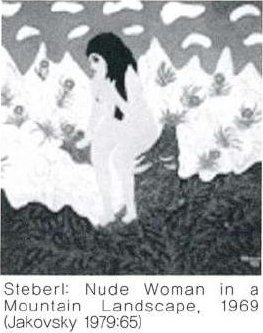
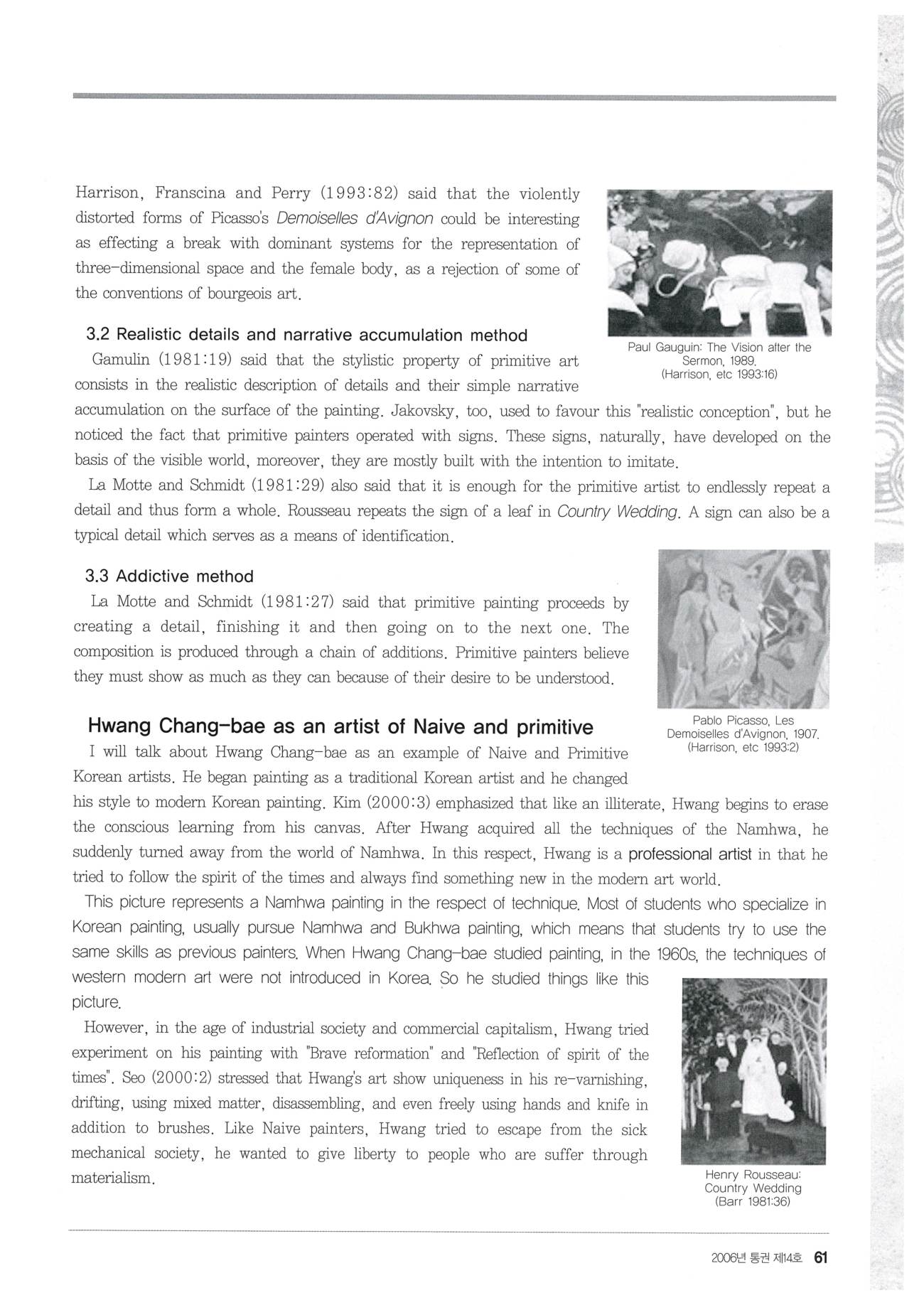
Gamulin (1981:17) said that Naive art is distinguished from folk art and popular art in that it does not depend on tradition, but begins entirely from the beginning. The result is an individual art with a personal repertory and philosophy of visual creation. Jakovsky (1976:65) explained that Steberl's Nude Woman in a Mountain Landscape has no special perspective, this being suggested by arranging the various pictorial elements in the manner of a back-drop. He does not reflect the real world, He uses a childlike imagination. He makes extensive use of flowers as ornamental and compositional elements.
3. Naive painters Express a personal vision.
Jakovsky (1979:5) said that a Naive painter has his own vision of the world which is unique and the individual vision of every Naive painter arises from a condition of the soul. According to Sedej (1981:9), the Croatian painter Ivan Rabuzin has stated that he is the god of his pictures and of his world, for it is a world which exists in his imagination.
Primitive Painting
Harrison, Franscina and Perry (1993) define the concept of primitive and primitivism as follows: Broadly speaking, the label 'primitive' has been used since at least the nineteenth century to distinguish contemporary European societies and their cultures from other societies and cultures that were then considered less civilized. The label 'primitivism', on the other hand, has generally been used to describe a Western interest in societies designated 'primitive', and their artefacts. Primitivism is generally used to refer to the discourses on the 'primitive'. There are three features: Primitivism is a modification of modern art, it expresses simple and innocent image and it refuses to follow the tradition,
1. Primitivism is a modification of modern art.
Gamulin (1981:20) said that primitive artists undoubtedly formed a separate group, more accurately a modification of modern art, ever since they appeared within modern art at the end of the nineteenth century. Especially, this grounded on a particular psycho-physical or socio-cultural structure of the object.
2. it Expresses simple and innocent images.
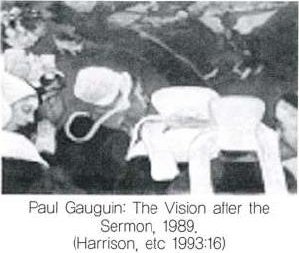
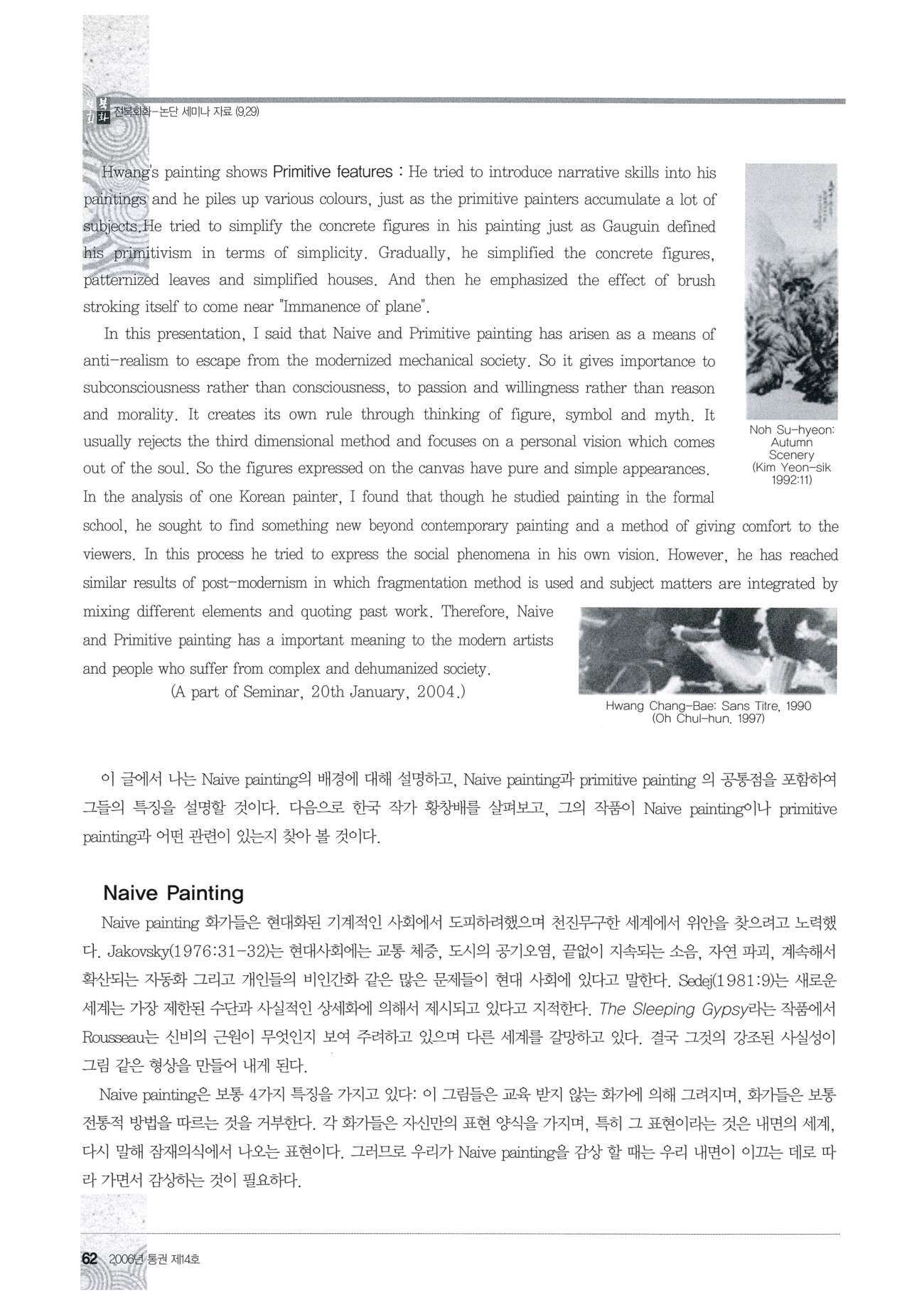
Gamulin (1981:15) said that the popularity of primitive art may reflect our society's collective longing for a simpler way of life, a state of innocence akin to childhood. Harrison, Franscina and Perry (1993:19) noted that Gauguin defines his primitivism in terms of the 'simplicity' in The Vision after the Sermon. He suggests that his formal simplifications are themselves symbolic of the 'primitive' culture. In this respect he was following a primitivist tradition which linked 'simple' people with 'purer' thoughts or modes of expression.
3. Refuse to follow tradition and express a personal vision
Gamulin (1981:18-21) stressed that primitive art has a complete lack of historicity. In the primitive, a stylistic organization takes place in a spontaneous and instinctive manner. So the primitive vision can be recognized in signs characteristic of spontaneity and isolation.
3.1 Primitive painters have a peculiar painting method. They use Second dimensional method and they reject the third dimension.
La Motte and Schmidt (1981:27) explained the Primitive painters present everything on the same plane, the important and unimportant, succession becomes parallelism. Trivialities are omitted, or else they are only used as ornamentation.
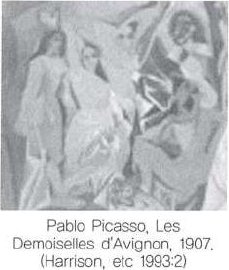
Harrison, Franscina and Perry (1993:82) said that the violently distorted forms of Picasso's Demoiselles d'Avignon could be interesting as effecting a break with dominant systems for the representation of three-dimensional space and the female body, as a rejection of some of the conventions of bourgeois art.
3.2 Realistic details and narrative accumulation method
Gamulin (1981:19) said that the stylistic property of primitive art consists in the realistic description of details and their simple narrative accumulation on the surface of the painting. Jakovsky, too, used to favour this "realistic conception", but he noticed the fact that primitive painters operated with signs. These signs, naturally, have developed on the basis of the visible world, moreover, they are mostly built with the intention to imitate.
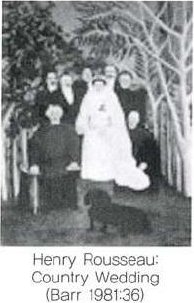
La Motte and Schmidt (1981:29) also said that it is enough for the primitive artist to endlessly repeat a detail and thus form a whole. Rousseau repeats the sign of a leaf in Country Wedding. A sign can also be a typical detail which serves as a means of identification.
3.3 Addictive method
La Motte and Schmidt (1981:27) said that primitive painting proceeds by creating a detail, finishing it and then going on to the next one. The composition is produced through a chain of additions. Primitive painters believe they must show as much as they can because of their desire to be understood.
Hwang Chang-bae as an artist of Naive and primitive
I will talk about Hwang Chang-bae as an example of Naive and Primitive Korean artists. He began painting as a traditional Korean artist and he changed his style to modern Korean painting. Kim (2000:3) emphasized that like an illiterate, Hwang begins to erase the conscious learning from his canvas. After Hwang acquired all the techniques of the Namhwa, he suddenly turned away from the world of Namhwa. In this respect, Hwang is a professional artist in that he tried to follow the spirit of the times and always find something new in the modern art world.
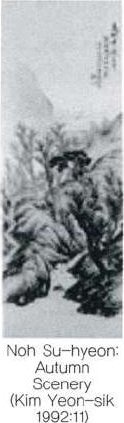
This picture represents a Namhwa painting in the respect of technique. Most of students who specialize in Korean painting, usually pursue Namhwa and Bukhwa painting, which means that students try to use the same skills as previous painters. When Hwang Chang-bae studied painting, in the 1960s, the techniques of western modern art were not introduced in Korea. So he studied things like this picture.
However, in the age of industrial society and commercial capitalism, Hwang tried experiment on his painting with "Brave reformation" and "Reflection of spirit of the times". Seo (2000:2) stressed that Hwang's art show uniqueness in his re-varnishing, drifting, using mixed matter, disassembling, and even freely using hands and knife in addition to brushes. Like Naive painters, Hwang tried to escape from the sick mechanical society, he wanted to give liberty to people who are suffer through materialism.
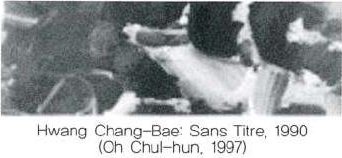
Hwang's painting shows Primitive features : He tried to introduce narrative skills into his paintings and he piles up various colours, just as the primitive painters accumulate a lot of subjects.He tried to simplify the concrete figures in his painting just as Gauguin defined his primitivism in terms of simplicity. Gradually, he simplified the concrete figures, patternized leaves and simplified houses. And then he emphasized the effect of brush stroking itself to come near "Immanence of plane".
In this presentation, I said that Naive and Primitive painting has arisen as a means of anti-realism to escape from the modernized mechanical society. So it gives importance to subconsciousness rather than consciousness, to passion and willingness rather than reason and morality. It creates its own rule through thinking of figure, symbol and myth. It usually rejects the third dimensional method and focuses on a personal vision which comes out of the soul. So the figures expressed on the canvas have pure and simple appearances. In the analysis of one Korean painter, I found that though he studied painting in the formal school, he sought to find something new beyond contemporary painting and a method of giving comfort to the viewers. In this process he tried to express the social phenomena in his own vision. However, he has reached similar results of post-modernism in which fragmentation method is used and subject matters are integrated by mixing different elements and quoting past work. Therefore, Naive and Primitive painting has a important meaning to the modern artists and people who suffer from complex and dehumanized society.
(A part of Seminar, 20th January, 2004.)
이 글에서 나는 Naive painting의 배경에 대해 설명하고, Naive painting과 primitive painting 의 공통점을 포함하여 그들의 특징을 설명할 것이다. 다음으로 한국 작가 황창배를 살펴보고, 그의 작품이 Naive painting이나 primitive painting과 어떤 관련이 있는지 찾아 볼 것이다.
Naive Painting
Naive painting 화가들은 현대화된 기계적인 사회에서 도피하려했으며 천진무구한 세계에서 위안을 찾으려고 노력했다. Jakovsky(1976:31-32)는 현대사회에는 교통 체증, 도시의 공기오염, 끝없이 지속되는 소음, 자연 파괴, 계속해서 확산되는 자동화 그리고 개인들의 비인간화 같은 많은 문제들이 현대 사회에 있다고 말한다. Sedej(1981:9)는 새로운 세계는 가장 제한된 수단과 사실적인 상세화에 의해서 제시되고 있다고 지적한다. The Sleeping Gypsy라는 작품에서 Rousseau는 신비의 근원이 무엇인지 보여 주려하고 있으며 다른 세계를 갈망하고 있다. 결국 그것의 강조된 사실성이 그림 같은 형상을 만들어 내게 된다.
Naive painting은 보통 4가지 특징을 가지고 있다: 이 그림들은 교육 받지 않는 화가에 의해 그려지며, 화가들은 보통 전통적 방법을 따르는 것을 거부한다. 각 화가들은 자신만의 표현 양식을 가지며, 특히 그 표현이라는 것은 내면의 세계, 다시 말해 잠재의식에서 나오는 표현이다. 그러므로 우리가 Naive painting을 감상 할 때는 우리 내면이 이끄는 데로 따라 가면서 감상하는 것이 필요하다.
1. Naive화가들은 교육 받지 못하고 사사받지 못한 화가들이다.
Jakovsky (1979:5)는 Naive 화가들이 사사받지 않았고 자신 만의 표현 양식들을 창조했다고 말한다. 이것은 역으로 '훈련받은' 화가는 결코 Naive 화가가 될 수 없다는 의미를 내포한다. Naive 화가는 아마도 유토피아와 잊혀진 인간 본연의 모습을 구하는 상징일지도 모른다. Jakovsky (1979:73)는 Ennulat가 그녀의 작품, Noah's Arc에서 원근법을 완전히 무시하고, 마치 천국에 있는 것처럼 이국적이고 순진무구한 동물들이 서로 함께 뒤 섞여 있는 모습을 그리고 있다고 설명한다.
2. Naive화가들은 전통을 따르는 것을 거부한다. 특히 그들은 3차원적 방법을 받아들이지 않는다.
Gamulin (1981:17)는 Naive 예술이 민속예술이나 대중 예술과는 다르다고 말한다. 왜냐하면 Naive 예술은 전통에 의존하지 않고 완전히 처음부터 시작하기 때문이다. 그 결과는 개인적인 철학과 독특성을 가진 시각적 창조물로써 개인적인 작품이 된다. Jakovsky (1976:65)는 Steberl의 Nude Woman in a Mountain Landscape는 어떤 특별한 원근법도 지니고 있지 않다고 주장한다. 여기에서는 다양한 그림적인 요소들을 배열하는 뒷 배경 조절 방법(the manner of a back-drop)을 사용하고 있다. 그는 실세계를 반영하지 않고 있다. 그는 아이 같은 상상력을 사용한다. 그는 광범위한 꽃을 장식적인 요소로 그리고 구성에 필요한 요소로 사용한다.
3. Naive 화가들은 개인적인 비전을 표현한다.
Jakovsky (1979:5)는 Naive 화가는 독특한 세계에 대한 자신 만의 비전을 가지고 있으며, 모든 Naive 화가의 개인적 비전은 영혼의 상태에서 생겨나게 된다. Sedej (1981:9)에 의하면, 크로아티아의 화가 Ivan Rabuzin가 그는 그의 그림과 그의 세계가 그의 상상 속에 존재하는 세계이기 때문에 그가 그의 그림의 신이다라고 말했다고 한다.
Primitive Painting
원시주의(primitivism)에 대한 개념부터 시작하면, Harrison, Franscina and Perry (1993) 는 Primitive와 primitivism의 개념을 다음과 같이 정의 한다: 넓게 말하면, 'Primitive' 라는 단어는 적어도 19세기부터 그 시대의 유럽 사회와 문화를 그 당시에 그들 문화 보다 덜 문명화 되었다고 생각되던 사회로부터 온 문화와 구별하기 위해서 사용되었다. 한편'primitivism' 라는 단어는 'Primitive'라고 칭해진 사회와 그들의 유물에 대한 서방의 관심을 묘사하기 위해서 일반적으로 사용되었다. 'primitivism' 은 일반적으로 'Primitive'에 대한 논의를 언급할 때 사용되었다.
primitivism에는 3가지 특징이 있다 : primitivism은 현대 예술의 변형이다. 이것은 단순하고 순진한 모습을 표현하며 전통을 따르는 것을 거부한다.
1. Primitivism은 현대 예술의 변형이다.
Gamulin (1981:20)는 19세기 말에 Primitive 화가들이 현대 미술에 모습을 들어 낸 이후로 의심할 바 없이 별도의 단체, 좀 더 정확히 말하면, 현대 예술의 변형을 꾀했다고 말한다. 특히 이러한 변형은 대상에 대한 특정한 심리-물리적 그리고 사회-문화적 구조에 근거하고 있다.
2. Primitivism은 단순하고 순진한 이미지를 표현한다.
Gamulin (1981:15)는 Primitive 예술이 단순한 삶과 어린 시절과 같은 순진한 상태에 대한 우리사회의 집합적 갈망을 반영하고 있다고 주장한다. Harrison, Franscina and Perry (1993:19)는 Gauguin이 그의 작품 The Vision after the Sermon 에서 그의 primitivism을 '단순성' 의 관점에서 정의하고 있다고 말한다. 그는 그의 형식적인 단순화는 그 자체가 'Primitive' 문화의 상직이라고 제안한다. 이러한 관점에서 그는 '단순한' 사람이 표현에 있어서 '순수' 한 생각이나 양식과 연결시키는 primitivist의 전통을 따르고 있다.
3. 전통을 따르는 것을 거부하고 개인적 비전을 표현한다.
Gamulin (1981:18-21)은 Primitive 예술이 역사성 완전히 부재하다는 점을 강조한다. Primitive 예술에서는 양식의 조직이 동시적이고 본능적 방법으로 일어난다. 그러므로 Primitive 비전은 동시성과 격리가 특징인 상징들 속에서 인식될 수 있다.
3. 1 Primitive 화가들은 독특한 그들만의 화법을 가지고 있다.
그들은 2 차원적인 방법을 사용하며 3차원적인 방법을 거절한다. La Motte와 Schmidt (1981:27)는 Primitive 화가들이 모든 것을 중요성에 관계없이 같은 면에 표현하며, 연속성이 결국 평행성을 만들게 된다. 사소한 것들은 생략되거나 아니면 그들은 단순히 장식으로 사용되게 된다. Harrison, Franscina and Perry (1993:82)는 Picasso의 Demoiselles d'Avignon에서 격렬하게 왜곡된 형태는 부르조아 예술의 일부 관행에 대한 거부로써 3차원적인 공간과 여성의 몸을 표현하는 주도적 시스템을 깨뜨리는 효과를 제공함으로써, 보는 이들로 하여금 재미를 더할 수 있다고 말한다.
3. 2 사실적인 상세성과 이야기적인 축적적 방법을 사용한다.
Gamulin (1981:19)는 Primitive 예술의 양식의 속성은 상세하게 사실적으로 묘사하는 것과 그들의 단순한 이야기를 그림의 표면에 축적적으로 표현하는데 있다고 말한다. Jakovsky(1979) 또한 이러한 사실주의적 개념(realistic conception)을 선호했지만, 그는 Primitive 화가들이 상징들을 가지고 그림을 그리고 있다는 사실도 눈치 챘다. 이러한 상징들은 눈으로 볼 수 있는 세계에 대한 기초에서 시작되었으며, 대부분이 모방을 하고자 하는 의도로 만들어 졌다. La Motte and Schmidt (1981:29) 또한 Primitive 화가들이 전체를 형성하기 위해 끝없이 상세한 것을 반복하는 것으로 충분하다고 말한다. Rousseau는 Country Wedding에서 나뭇잎의 상징을 계속해서 반복한다. 어떤 상징은 확인의 수단으로 역할을 하도록 전형적인 상세화가 될 수도 있다.
3. 3 첨가적 방법을 사용한다.
La Motte and Schmidt (1981:27)는 Primitive 그림이 상세한 것을 만들고, 그것을 마치고 다시 다음 상세한 것을 그리는 연속적인 행위라고 말한다. 그림의 구성은 연속적인 첨가를 통해서 이루어진다. Primitive 화가들은 자신들을 이해시키고자 하는 욕망 때문에 가능한 한 많은 것을 보여 주려고 노력한다.
Naive 및 Primitive 기법을 사용한 작가 Hwang Chang-bae
Naive 또는 Primitive 화가로서 황창배에 대하여 논의 하겠다. 그는 전통적인 방법으로 그림을 시작한 한국 화가이다. 그러나 그의 양식은 현대화된 한국화로 바꾸었다. Kim (2000:3)은 황창배가 문맹인처럼 그의 캔버스에서 의식적으로 배운 것들을 지우기 시작했다고 말한다. 황창배는 남화로부터 모든 화법들을 배운 후에 갑자기 남화의 세계에서 돌아선다. 이런 면에서 황창배는 전문적인 화가이다. 왜냐하면 그가 항상 사물의 정신을 따르려 노력하고 현대의 예술세계에서 항상 무엇인가 새로운 것을 찾으려 노력하기 때문이다.
이 그림은 기술적인 면에서 남화에 속한다. 한국화를 전공한 대부분의 학생들은 보통 남화나 북화를 공부한다. 이 의미는 학생들이 기존의 화가들의 화법과 같은 기법을 사용하려한다는 것이다. 황창배가 그림을 배울 때인1960년대에는 서구 현대 예술의 기법이 한국에 많은 영향을 끼치지는 못하고 있었으나 산업화 사회와 상업 자본주의 사회에서 그는 '대담한 변형' 과 '시대정신의 반영' 을 통해 그의 그림에 실험을 시도한다.
Seo (2000:2) 는 황창배의 그림이 덧칠하고, 되는 데로 그리고, 혼합 재료를 사용하고, 분해하고 심지어는 붓 대신에 손과 칼을 자유롭게 사용하여 독특성을 보여주고 있다고 말한다. Naive 화가들처럼 황창배는 병든 기계적인 사회에서 도피를 시도했으며, 그는 물질주의로 고통 받는 사람들에게 자유를 주기를 갈망했다.
황창배의 그림은 Primitive 특징을 보여 준다: 그는 그의 그림에 이야기체의 기법을 도입하려 하였으며, 그는 Primitive 화가들이 다양한 소재를 첨가적으로 쌓듯이 다양한 색깔을 덧칠했다. 그는 Gauguin이 primitivism은 단순성의 관점에서 정의 했듯 그의 그림속의 구체적인 형상들을 단순화 하려고 노력했다. 점차적으로 그는 구체적인 형상을 단순화하고, 나뭇잎들을 규칙적으로 반복했으며, 집들을 단순화했다. 그리고 난 후 그는 면의 내재성에 접근해 가기 위해 붓 터치 자체를 강조했다.
이글에서 나는 Naive painting과 Primitive painting이 현대화된 기계적인 사회에서 도피하기 위한 반-사실주의의 수단으로 생겨나게 되었음을 보였다. 그러므로 그들은 의식보다는 잠재력에 이성과 도덕성 보다는 열정과 의지에 중요성을 두었다. 이것들은 형상, 상징, 신화에 대한 생각을 통해 그 나름의 규칙을 창조해 내었다. 이것은 보통 3차원적인 방법을 반대하고 정신에서 나오는 개인적 비전에 중점을 두었다. 그러므로 캔버스에 표현된 형상들은 순수하고 단순한 모습을 표현하게 되었다.
황창배는 공식적인 학교에서 공부를 했지만, 동시대의 그림을 넘어서 새로운 무엇인가를 발견하려 노력했으며 그림을 감상하는 사람들에게 위안을 줄 수 있는 방법을 찾으려 했다는 것을 알았다. 이러한 과정에서 그는 자신의 비전으로 사회 현상을 표현하려 했다. 그러나 그들은 조각화(fragmentation) 방법과 다른 요소들을 섞고 과거의 작품들을 인용하여 소재를 통합하는 포스트모더니즘과 유사한 결과에 도달했다. 그러므로 Naive painting과 Primitive painting은 복잡하고 비인간화된 사회에서 고통 받고 있는 현대 예술가들과 사람들에게 중요한 의미를 갖는다.
Bibliography
Kim, B. J. http://www.hwangchangbae.com/critic_2.htm. 10th October, 2003 Visit.
Kim, Y. S. 1992. Six Oriental Painting Artist Exhibition. Seoul: Semo Gallery.
Barr, P. T. 1981. 'Henri Rousseau'. in Zdunic, D. Primitive Painting. New York:The Alpine Fine Art Collection Ltd.
De La Motte, M. and G. Schmidt. 1981. 'The Primitive Consciousness' in Zdunic, D. Primitive Painting. New York: The Alpine Fine Art Collection Ltd.
Emmerling, L. 2003. Basquiat. Köln: Taschen.
Gamulin, G. 1981. 'Toward a Theory of Primitive Art'. in Zdunic, D. Primitive Painting. New York:The Alpine Fine Art Collection Ltd.
Harrison, C., F. Frascina and G. Perry. 1993. Primitivism, Cubism, Abstraction : The Early Twentieth Century. London: Open University Press.
Jakovsky, A. 1979. Naive Painting-Phaidon 20th-century Art. Oxford: Phaidon Press Limited.
Oh, K. S. 1997. Korean Painting Tradition in Modernism: Hanguk-hwa. Seoul: Beaux Arts.
Paul Gauguin. The Vision after the Sermon, 1989. (Harrison, etc 1993:16)
Seo, S. R. http://www.hwangchangbae.com/critic_1.htm. 10th October, 2003 Visit.
Sedej, I. 1981. 'Primitive Art in the Modern World'. in Zdunic, D. Primitive Painting. New York:The Alpine Fine Art Collection Ltd.
원 게재: 전북회화-논단 세미나 자료 (9.29) / 회화지 14호(2006) 59–65쪽 · 원본 PDF 59쪽 ↗